Wagga Tree Services connects Wagga Wagga and the Riverina property owners with qualified, insured local arborists for tree pruning and related tree work. Tell us what the tree is doing and we'll match it to an operator who covers your suburb — free call, no obligation.
The main types of pruning
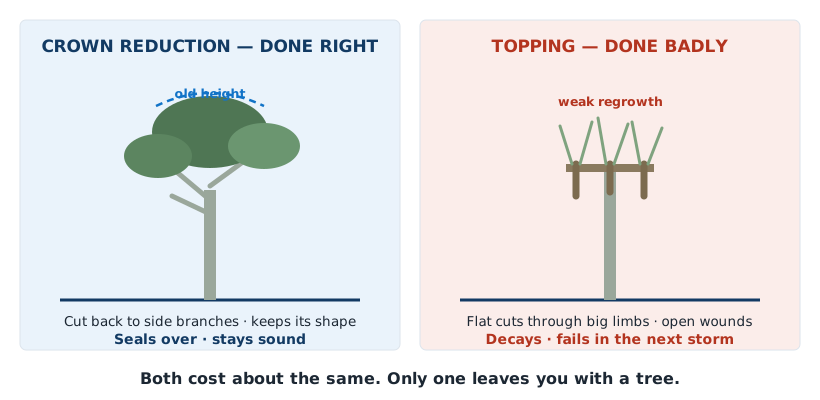
Deadwooding removes dead branches from a living canopy — the single highest-value job for safety, and it doesn't need council consent. Crown thinning selectively removes branches to reduce density, letting wind through instead of turning the canopy into a sail. Crown lifting takes the lowest branches to clear a driveway, roofline or footpath. Crown reduction shortens the canopy overall while keeping its natural shape. Formative pruning on young trees sets good structure early and prevents the weak unions that fail twenty years later.
When to prune in the Riverina
Most species handle pruning best in late winter to early spring, before the flush of new growth. Avoid heavy work on stressed trees in the depths of a hot dry summer — you're asking a tree already under water stress to seal fresh wounds.
Deadwooding and genuine hazard reduction are exceptions. If a limb is dead over a driveway, the right time to deal with it is now.
Pruning prevents the expensive job
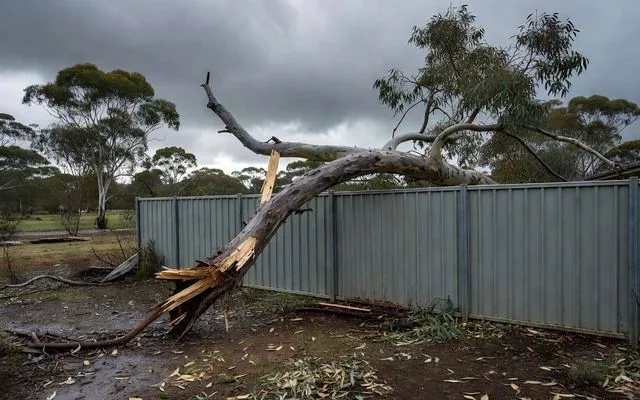
The pattern is predictable. A tree gets no attention for fifteen years, develops a heavy one-sided canopy and some deadwood, then a storm takes half of it out and the whole tree has to come down. Periodic pruning at $200 to $800 a visit is markedly cheaper than a $3,000 emergency removal plus fence repairs.
For mature trees near structures, an inspection every two to three years is reasonable.
If council issues a pruning permit, the standard is set
Where the tree is protected and council grants a permit to prune, the work must be carried out by a minimum AQF Level 2 arborist in accordance with AS 4373-2007, the Australian Standard for pruning of amenity trees. You also need to keep the completed permit form for a year.
It's a useful benchmark even when no permit is involved — if an operator doesn't know what AS 4373 is, that tells you something. Council's requirements are set out here: Removing private trees — Wagga Wagga City Council.
What it costs
Pruning generally runs $200 to $1,200 depending on tree size, height, access and how much material comes out. Small ornamental work sits at the bottom of that range; a full crown thin on a mature red gum near a house sits at the top.
Areas covered
Wagga Wagga and the surrounding Riverina.