Wagga Tree Services handles dead trees and related tree work for property owners across Wagga Wagga and the Riverina. Tell us what the tree is doing, and we quote it once we have seen it — no obligation.
How to tell a tree is actually dead
In winter it can be hard to be certain. The reliable checks are a scratch test — scrape a small patch of bark on a few different limbs, and green underneath means living tissue — plus bark that's peeling away in sheets, fungal brackets at the base or on the trunk, and fine twigs that snap cleanly instead of bending.
A tree can also be dead in parts. Half a canopy gone while the rest looks fine usually means something is wrong at the roots or in a major limb, and that's worth an assessment before you decide.
Why dead trees are harder, not easier, to remove
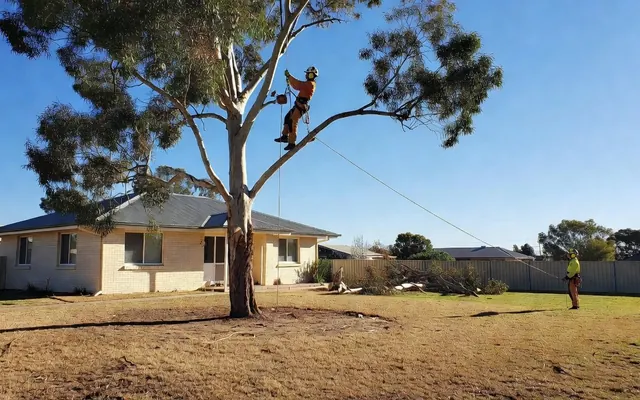
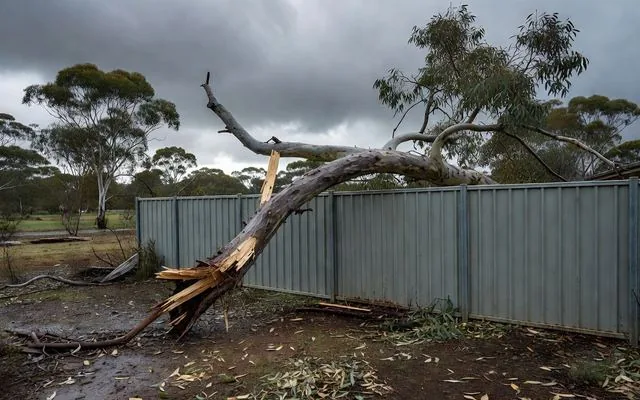
People assume a dead tree is a simpler job because there's no canopy to deal with. The opposite is true. Dead wood is brittle and behaves unpredictably under a saw. Limbs that look solid can shear without warning, and a climber can't rely on the structure to hold their weight.
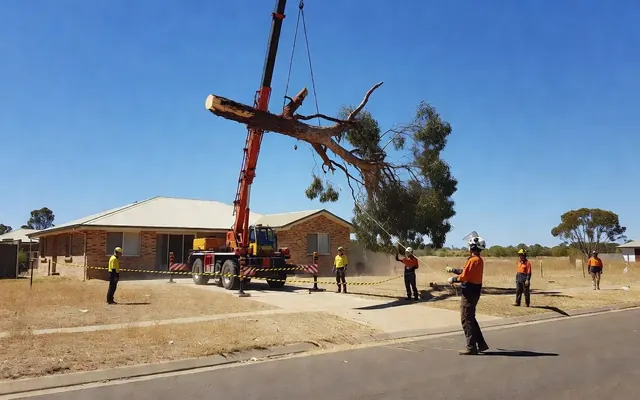
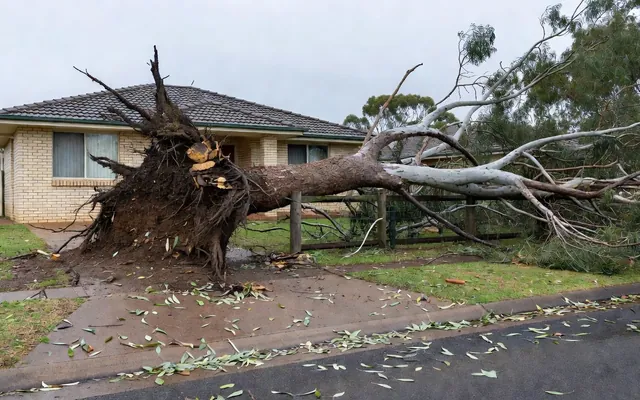
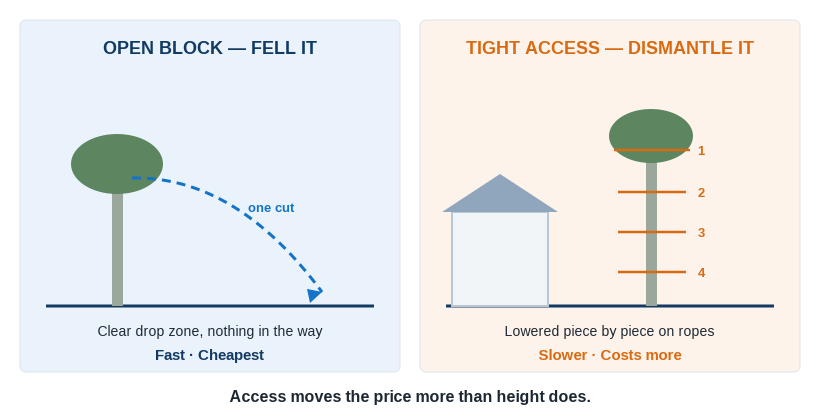
That often pushes the job toward an elevated work platform or a crane rather than a climb — which costs more than the same tree would have cost alive. Left long enough, decay at the base makes the direction of fall genuinely unpredictable, and that's when it becomes an emergency rather than a booking.
The council exemption — and where it stops
Wagga Wagga City Council doesn't require consent to remove a dead tree, and it doesn't require consent to take dead branches out of a living tree's canopy either. That's the one part of the tree rules that works in your favour.
Where it stops is the word "dead". A tree in severe decline — half a canopy gone, bark shedding, but still alive — is a living tree under the rules, and if it's 8 metres or taller it still needs a permit. If there's any doubt about whether the tree is genuinely dead or just severely stressed, get it assessed. Removing a living protected tree on the assumption it was dead is not a defence.
What it costs
Broadly the same bands as any removal — $250 to $800 for small, $800 to $2,500 for the typical suburban tree, $2,500 upward past 10 metres. Expect the upper end of the band rather than the lower one, because the method is usually more cautious.
The cheapest time to remove a dead tree is as soon as you know it's dead.
Areas covered
Wagga Wagga and the surrounding Riverina.